

Jump to content

Yankee4Life

Administrator
  • Posts

    21498
  • Joined

  • Days Won

    82

Everything posted by Yankee4Life

  1. Oscar Melillo It sounds like a parody of Popeye, but the doctor was deadly serious when he told Oscar Melillo in 1926 that if he wanted to live he could eat nothing but spinach. Facing a potentially fatal kidney problem (Bright’s Disease), the 27-year-old Melillo wisely followed the doctor’s remedy and recovered from the disease, enabling him to continue his baseball career and live to the age of 64. Rather than having parodied Popeye in fact, Melillo’s story may have actually inspired it. The comic strip was created three years after Melillo’s diagnosis, by E.C. Segar, who may have known of the ballplayer’s story. Melillo reached the major leagues in 1926 after six seasons in the minors. He then played 12, through 1937, mostly as a second baseman. The first nine-plus were for the St. Louis Browns and the final nearly three seasons were as a member of the Boston Red Sox. He finished with a career .260 average, driving in 548 runs and scoring 590. Melillo then coached at the major-league level for 13 more years. Melillo was of slight stature, standing 5-feet-8 and weighing 150 pounds. He was born on August 4, 1899, in Chicago to Italian immigrant parents Maria Scaldaferri and James Melillo, a painter and shoe cobbler. Both had come to the United States from Tuscany in 1883. Oscar was the youngest of five children; his older siblings included Josephine, Munzie, James, and Rosie. He started a working life early, dropping out of high school almost as soon as he got there, “playing hookey and golf and baseball, particularly baseball.” He took a job in the office of the Chicago & Eastern Illinois Railroad, attending night school to take stenography, but too much teasing about being a “sissy” led him to apprentice as a tool maker at International Harvester in West Pullman, Illinois – certainly a more masculine-sounding job. He started playing baseball on weekends with the Alma Maters, the company semipro team. A connection to International Harvester dated back to his grammar school days. The company’s football team had a popular left tackle named Frank Fiske, whose nickname was Ski. Some of the other kids saw the way Melillo kicked the ball and helped pin the nickname on him. Years later, when he himself was working for the company, Oscar cheered Fiske on so much that his fellow workers started calling him “Ski” as well. Catcher Jake “Tomatoes” Kafora, who played in parts of a couple of years with the Pittsburgh Pirates, recommended him for his first job on organized ball, to manager Jack Sheehan of the Winnipeg Maroon. He signed with them in the fall of 1919. He played two years of outfield in the Western Canada League in 1920 and 1921. After the two years of Class B ball, it was on to Milwaukee, where he played four years (1922 through 1925) in the American Association, improving his average each year from .280 to .294 at Double A. His contract had been packaged as a late “throw-in” when the Brewers bought pitcher Eddie Schaack. Midway into his second year with the Brewers, he transitioned to the infield when the team’s second baseman, Fred “King” Lear, jumped the club to play with a team in the Wisconsin Industrial League. Oscar had played second base with the team in some postseason barnstorming in the fall of 1922, so he volunteered to take the job; shortstop Johnny Cooney seconded the notion, and he kept it. His final year with the Brewers, 1925, saw a .294 average, with 46 extra-base hits (13 of them home runs). Major league scouts were following him, and the Brewers reportedly turned down $50,000 in cash but accepted five ballplayers from the St. Louis Browns. Manager George Sisler was trying to strengthen the Browns’ defense and dealt for the second baseman that some writers were beginning to call “the new Lajoie.” With Milwaukee, Melillo had set a new record, handling 1,096 chances at second in 1925, and took part in 132 double plays. In the fifth game of the 1926 season, he took over late in the game for third baseman Gene Robertson and went hitless in his first major-league at-bat. His first hit came the next day, a double with a run batted in. His first game-winning hit came later in April, as he singled in the bottom of the 12th inning in a 2-1 victory over the White Sox. He didn’t homer often (22 in his 12 seasons); the first and only one of his rookie year was hit off Washington pitcher Dutch Ruether on June 18, tying the game in the eighth inning. His fielding won acclaim: On July 21 the New York Times wrote, “One reason the Yanks lost was Melillo’s beautiful stop of Keonig’s fast grounder near second, resulting in a double play of what should have been a base hit. Ruth’s homer followed immediately, but nobody was on.” Melillo appeared in 99 games in 1926,a year in which the Browns tumbled to seventh place after they finished third the year before. Melillo’s season had ended prematurely, after the August 9 game when he was hospitalized for six weeks with what was described as “complications due to a bad case of tonsillitis.” Indeed, he was only released at the end of October, after being diagnosed with what was termed kidney poisoning. For the season he batted 255 with 29 RBIs and 54 runs scored. His fielding was good – although he committed 22 errors, that was just two more than player-manager Sisler at first base and far fewer than Wally Gerber’s 37 at short. Following the kidney poisoning diagnosis, Melillo began his unusual diet. “They told me to eat nothing but spinach for the next few months if I wanted to live,” he said. “I tried to talk them into letting me have a steak, spaghetti, ravioli, or goulash once in a while, but they said nothing doing. When I told them I couldn’t stand the monotony of spinach three times a day, they told me I could have some variety by boiling it for breakfast, making a salad of it for lunch, and baking it for dinner.” Between meals, he was allowed to chew on raw carrots. It’s not surprising that he also earned the nickname “Spinach.” He was fortunate to survive, but there he was reporting to the Browns for spring training in 1927. He played all season long, getting spelled a couple of times a week while appearing in 107 games. He didn’t hit as well (.225), though, and his fielding suffered (36 errors, a .935 fielding percentage). Still, at the end of the year manager Dan Howley had him penciled in as his regular second baseman for 1928. In the spring, however, Otis Brannon played so well that he looked to have taken the position from Melillo by the end of March. Melillo had suffered some illness over the winter, so his stamina may not have been what it should have. There were several stretches in the 1928 season when Melillo had to sit out for a week or more. It was a disappointing year in which he struggled to play as regularly as he would have liked, and he only hit .189 in his 132 at-bats. Brannon hadn’t hit that well that season, either. As a result, the team pinned some hopes on prospect Eddie Grimes, and Melillo was seen as a reserve for the 1929 season – until that spring, when he proved himself and became Howley’s starting second baseman by Opening Day. On May 5, he had the only hit against Rube Walberg, denying him a no-hitter, but in general he started slowly, only really passing the .250 mark around the end of June. He had a strong second half though, finishing with a .296 average – well above the team’s .276 average – in 141 games, driving in 67 and improving in the field. St. Louis finished fourth, two games behind the Indians. Bill Killefer took over the helm in 1930, but the team sank to sixth. Melillo’s average dropped to .256 that season, although the team’s average was only .268. He played in all but five games, clearly having addressed his health issues. In 1931, Melillo had his best year, batting .306 and at times was among the league leaders in the early going, batting around .340 as late as mid-June. He drove in 75 runs. In the field, he handled 1,003 chances. He even placed eighth in the most valuable player voting, and earned an extra $3,000 thanks to a bonus for hitting .300 promised him by owner Phil Ball. In 1933, he set a career mark with 79 RBIs, in part on the strength of a .292 average. His fielding was excellent, at one point handling 316 chances without an error and setting a new record at second base with a .991 fielding percentage. Rogers Hornsby took over as manager about two thirds through the season, but the Browns finished last. They’d still never won an American League pennant. Not surprisingly for a last-place team, there were trade rumors throughout the offseason, and Melillo was often among them. He wasn’t moved, though, and played another full season in 1934. His average fell once more, down to .241. Though St. Louis climbed back to sixth place, Hornsby announced that for 1935 everyone was on the trading block. Joe Cronin had taken over as manager for the Red Sox, Tom Yawkey’s checkbook was open, and the Red Sox were looking for a second baseman. There were rumors galore during the winter, but nothing came of it until May 27. The two teams finally made a trade, with Melillo going to Boston and Moose Solters and a reported $25,000 in Yawkey cash going to St. Louis. Because of his inconsistently at the plate, his fielding was what kept him in the game. He played a deep second base and excelled at positioning himself well, anticipating the action – “playing the batter.” Hornsby wasn’t happy to give up so much on defense, but said he really needed a .300 hitter. Solters came through and hit .330 for him. Melillo had only been hitting .210 before the trade, no doubt a little preoccupied with all the rumors. After he landed with the Red Sox, he hit. 260. In Boston, he found himself with a home locker next to Lefty Grove. That presented an awkward situation because of a moment on August 23, 1931 when Oscar’s RBI double for a 1-0 Browns win had prevented Grove from extending his streak of 16 consecutive wins. Grove had never spoken to Melillo again, and didn’t for the first several weeks they were lockering neighbors. Finally, Grove relented and told him, “You’re eating with me tonight.” He was the starting second baseman in 1936, too, but appeared in only 98 games and hit just .226. He was 36 and perhaps starting to show his age, with a series of minor injuries that limited his playing time, though he did not miss any long stretches. A young ballplayer from Southern California joined the Red Sox in 1937: Bobby Doerr. It became Melillo’s job to tutor the promising prospect. It was predicted that he “may not appear in 50 ball games, but if Manager Joe Cronin carries out his plans the infielder will earn his salary.” It turned out to be Eric McNair who moved over from shortstop to second and handled the lion’s share of the action, while Doerr became accustomed to major league ball. Melillo appeared in just 26 games, hitting an even .250. In early December, Melillo requested and was granted his release so he could take up a job with the Browns as a coach under Gabby Street. Doerr said, early in the season, “I’ve learned more about second base just watching Ski these few weeks than I picked up in my whole three years on the coast.” He coached off and on through 1956, first with the 1938 Browns (managing the last 10 games of the season after Gabby Street left the club, finishing 2-7 with one tie.) He later served as a coach for the Indians under Oscar Vitt and Lou Boudreau. After the 1947 season, he was dropped from Boudreau's coaching staff at the insistence of owner Bill Veeck. Melillo spent part of 1948 managing in the Indians' farm system, but returned to Cleveland to serve part of the year as an aide to Boudreau for the 1948 world champions. After spending the 1949 season as a minor league manager, he coached under Boudreau in 1950, his final year with the Indians, then again with the Red Sox and Kansas City Athletics.
  2. 8 out of 10, 80 seconds. These questions were a struggle but not impossible but I should have done better. I can not get going this month.
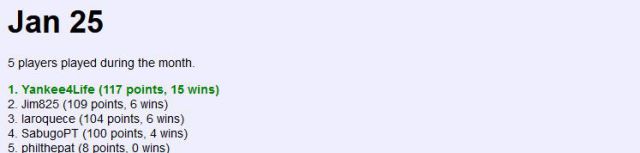
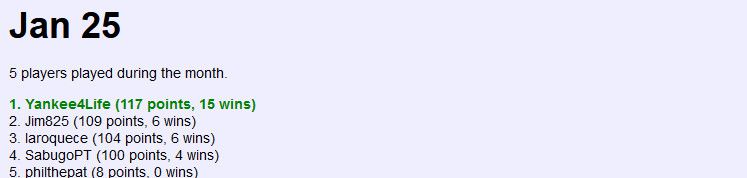
  3. He is unstoppable this month! Not counting today he has won eight of the sixteen days! 👏
  4. 10 out of 10, 36 seconds. I had some pressure on me trying to keep up with everyone else today. Can you believe there are two weeks left?
  5. 8 out of 10, 54 seconds. Again I missed one I should have easily had.
  6. 9 out of 10, 37 seconds. No, just no. It should have been a clean sweep today. It's been a hard month.
  7. 6 out of 10, 76 seconds. The time may not have been there for me but it never is on Thursdays but I'm happy because I was given a rare Oakland Raiders question that I had no chance of missing.
  8. 9 out of 10, 72 seconds. I took it a little slower today based on the questions that were thrown at me and it worked out well. I figured I had to do well today because Thursdays for me can be a struggle.
  9. 6 out of 10, 69 seconds. I should be happy that I got this many right but I'm sitting here wondering how I did it. 😄
  10. 5 out of 10, 55 seconds. As soon as I read question one which was a baseball card question I knew I was in trouble. Turns out I was right! 🙂
  11. 10 out of 10, 32 seconds. Everything went well today which was very surprising.
  12. Muller, version 3 was released in December of 2023. What has been updated recently?
  13. 7 out of 10, 57 seconds. The three I missed I deserved to. I had no idea at all. But there was one question that I believe should not have been there. It should have been in the easy questions and not the difficult ones. Hey, at least I didn't miss it like I did the Lou Gehrig one!
  14. 9 out of 10, 37 seconds. I am going to show you what happens when you try to go too fast and do not read the questions all the way. As a baseball fan and a Yankee fan I am embarrassed. 😮
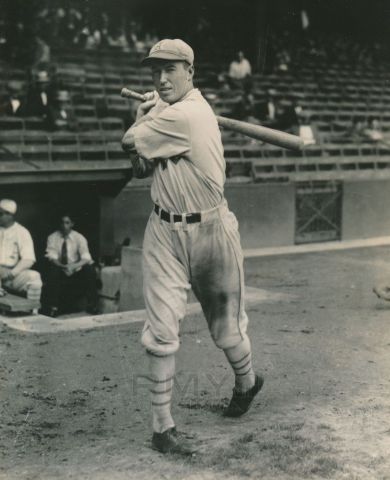
  15. Baby Doll Jacobson A big, hulking 6-foot-3, 215-pound outfielder named Baby Doll? There has to be a story behind that nickname. More than one, as it happens, though they overlap. The story out of Jacobson’s own mouth is probably the right one. In his obituary, The Sporting News quoted him: “Everybody called me Bill until that day in Mobile. It was opening day and a band was playing. Just before the first pitch, they struck up ‘Oh, You Beautiful Doll,’ a popular song at the time. Well, I led off with a homer on the first pitch and a lady sitting behind the plate jumped up and shouted: ‘You must be that beautiful doll they were talking about.’ The name stuck with me and that was it.” The next day’s Mobile Register ran his photograph with the caption “That Baby Doll.” Bill Jacobson was born in Cable, Illinois, on August 16, 1890, to Swedish father Gustaf Jacobson and his wife Albatina, born in Illinois but to two Swedish parents. Gustaf Jacobson is listed in the 1910 census as a general farmer. William Chester Jacobson was the oldest of four children, the others being Vern, Gertrude, and Mary. Bill played 11 seasons of major-league ball from 1915 to 1927 and, playing for five different teams, hit a productive .311 for his career, with 83 homers and 818 RBIs in 1,472 big-league games. It was for the St. Louis Browns that he worked 1,243 of those games. Cable is even in the early 21st century an unincorporated community in western Illinois about 20 to 25 miles south of Davenport, Iowa. Bill Jacobson attended what he described as a “country school” there for eight years, and then moved and went to high school in Geneseo for 3¾ years. Perhaps the demands of farming prevented him from fully completing high school. It may also have been the opportunity to begin his first year in professional baseball, a few months before he turned 19. The first team to hire him was the Rock Island Islanders of the Class B Three-I League. In 1909 he appeared in 43 games, batting .185 with six extra-base hits but no home runs. His first work was as both an outfielder and a catcher, the latter position one where hitting for average was not as important. In 1910 Jacobson spent most of the year in Class D with the Southern Michigan League’s Battle Creek Crickets. He had begun the year with Rock Island, but was hitting just .140 and seeing infrequent action before being optioned to Battle Creek in mid-August. There he hit for a .223 mark in 55 games. He returned to Rock Island in 1911 and found his stroke, playing in an even 100 games and hitting .304, with his first four home runs. Seventy of those games saw him catching. His contract was purchased by the New York Giants in September for $3,500. Manager John McGraw ranked Jacobson high, claiming that the Three-I statistics were incorrect and that Jacobson had hit .328 and led the league. He called Jacobson “one of the most determined players I ever saw.” Writers were impressed with his size, calling him “massive” and “a mountain in size.” He was indeed one of the bigger men in baseball during his day. He worked hard and took seriously McGraw’s instructions regarding hitting and baserunning during spring training in Marlin, Texas. The Giants released Jacobson to the Mobile Sea Gulls in March 1912 as they began to play their way to the north, and “Big Bill” played in the Class A Southern Association for Mobile in 139 games, hitting .261. After 1911, he is listed strictly as an outfielder. Procedurally, the Giants recalled him on August 28, but he was sold to Mobile on April 25, 1913. He didn’t hit as well (.244) and didn’t play in as many games (54) in 1913, in large part because he was suspended by the Sea Gulls on July 9. Four weeks later, Mobile sold Jacobson’s contract back to the Giants. New York sold his contract to Chattanooga (another Southern Association team) for the 1914 season, where he played in 155 games for the Lookouts, batting .319 with 15 home runs. They took advantage and sold Jacobson’s contract to the Detroit Tigers. Jacobson made his debut in the major leagues on Opening Day 1915 in Detroit. Major-league pitching was, of course, higher caliber than any he had faced before. He hit .215 in 37 games for the Tigers, but with Ty Cobb and Sam Crawford both playing in every one of Detroit’s games all season long and left fielder Bobby Veach missing only four, Jacobson’s time was limited to pinch-hitting, filling in now and again, and some late-inning work. The Tigers were in a pennant race with the Boston Red Sox (finishing only 2½ games behind), and manager Hughie Jennings was pleased to pick up right-handed pitcher Bill James from the St. Louis Browns for Jacobson and $15,000 on August 18. James contributed seven wins (7-3, 2.42 ERA) in what remained of the season. Jacobson hit .209 for the Browns in the closing weeks, one of the hits his first big-league home run, on September 14 in Philadelphia. Another year of seasoning in the minor leagues saw Baby Doll in Little Rock with the Travelers, his third Southern Association team. If he might not have seemed ready for the bigs, he was perhaps overqualified for A ball. He hit .346 with six home runs, and in 1917 he was back with the Browns as their regular right fielder, hitting .248 and driving in 55 runs. Just before the end of the year, he was in the United States Navy and missed the entire 1918 season while the World War was in progress. He was discharged on January 2, 1919, and rejoined the Browns. That March he married Vurl Cruse. Jacobson was 28 when he returned from the service, and he hit well over .300 for each of the next seven seasons, beginning with .323 in 1919 and – playing every game of the season – a career-high .355 in 1920 – driving in 122 runs, tied with teammate George Sisler, with the two of them second only to Babe Ruth’s 137 RBIs. In the offseason, he worked as a millwright in a tractor works. Jacobson was the center fielder for St. Louis throughout. He credited manager Jimmy Burke for helping turn his career around when, before the 1919 season, Burke called him aside. He asked Jacobson, “Say, you big stiff. Where’s your wife?” Jacobson said she was in Illinois. Burke said he thought she always stayed with him during the season, and Jacobson replied she did, when he was settled down for the summer. “Send for your wife today,” Burke told him. “You’re settled down for the summer.” He’d made the team and wasn’t going to be sent down again. He told reporter John B. Sheridan that he had started seeing the ball better than he ever had before, now that he was relieved of the worry he’d always had. “After five years of trial and five years of failure I have made good at last. That’s all I know. Whatever improvement I have shown is due to Burke’s four words, ‘Send for your wife.’ When Burke made that crack, he made me a success where I had been one of the most pitiable failures in baseball.” The Browns climbed into the first division, then went to third place in 1921 (with Jacobson .352, 90 RBIs) and second place in 1922 (.317, 102 RBIs). He may not have had great speed, but in one game in 1922 he hit three triples against the Tigers. The St. Louis outfield featured Ken Williams, Jacobson, and Jack Tobin; from 1919 through 1923 each of them hit over .300, and in 1924 Tobin missed by just one point (.299). From 1923 through 1925, Jacobson hit .309, .318, and .341, still producing runs (he scored 103 runs both in 1924 and 1925). His 19 homers in 1924 were the most he ever hit; he was third in the American League behind Babe Ruth and Joe Hauser. One of his homers that season was part of hitting for the cycle on April 17. That same year he set a major-league fielding record, with 488 putouts, which he held until Dom DiMaggio broke the record with 503 putouts in 1948. Jacobson reportedly held 13 fielding records at one time or another. The secret wasn’t his speed. It was average at best compared with other outfielders of the day. “Play the batters and you have the secret,” he explained. There was, however, also a stretch with the Red Sox in 1927 when he played in seven consecutive games without recording either a putout or assist. Jacobson also expounded at some length to baseball writer F.C. Lane as to the importance of form in batting, and how he had adopted his own style, the one that suited him best. After 50 games in 1926, the Browns traded Jacobson to the Philadelphia Athletics for Bing Miller as the two teams swapped center fielders. Jacobson had been hitting .286. Miller hit .331 for the Browns, but Jacobson never played for the Athletics in 1926. The same day he was acquired by them, Philadelphia packaged him in a trade to the Red Sox, sending Slim Harriss, Fred Heimach, and Jacobson to Boston for Howard Ehmke and Tom Jenkins. For Boston, Jacobson played all three outfield positions, though mainly center and right. He hit for a .305 average and drove in 69 runs in the 98 games he played for the last-place Red Sox. His best day was soon after he arrived; he went 4-for-6 with a homer and a double on June 21, 1926. Baby Doll’s time with Boston lasted almost precisely one year. He was sold on June 12, 1927, to the Cleveland Indians. That season he hit .245 in 45 games for the Red Sox, then .252 in 32 games for the Indians, who placed him on waivers, where he was claimed by the Athletics on August 5. Finally getting his chance to play for Philadelphia, he got into just 17 games, hitting .229 with one final home run. Jacobson was 36 years old but wasn’t ready to return to the farm quite yet, and he played two more years in the minor leagues, doing duty with four teams in 1928 (Chattanooga, Baltimore, Toledo, and Indianapolis). He was .342 in the American Association for the two latter teams. In 1929, his final year, he played in Class B baseball, for the Quincy Indians of the Three-I League. He hit for a .304 average, then retired to work his farm in Coal Valley, Illinois. He did play some semipro ball in the Henry County League in 1930. He was one of the best defensive outfielders of his era. He set 13 defensive records during his career, and his 488 putouts in 1924 stood as a major league record until 1928 and an American League record until 1948. He also led the major leagues with nine double plays started from the outfield in 1925.
  16. 8 out of 10, 47 seconds. I know how Sabugo feels because I had an Oakland Raiders question today and I did not miss it!
  17. KC, you may not make a lot of posts in here but they are always informative, educational, well thought out and most of all correct. Thank you.
  18. 9 out of 10, 62 seconds. A lucky day for me since I guessed right on four out of five questions.
  19. 4 out of 10, 58 seconds. Thankfully they had mercy and they threw me some baseball questions.
  20. It’s time for my annual who stays and who goes list. Pitchers Get some rest over the winter and be prepared to work on fundamentals: Gerrit Cole, Luis Gil, Clarke Schmidt, Carlos Rodon, Luke Weaver, Will Warren, Marcus Stroman, Clayton Beeter, Jake Cousins, Cody Poteet, Ian Hamilton, Mark Leiter, Jr. Enough already! Nestor Cortes, Clay Holmes You waste of space Jonathan Loaisiga Re-sign him Tim Hill, Tommy Kahnle Hitters Like the pitchers, get some rest and then be prepared in February to work on something called “fundamentals.” You can do it. I have faith in you. Oswaldo Cabera, Jazz Chisholm, Jr, Anthony Volpe, Aaron Judge, Giancarlo Stanton They deserve a decent shot. Oswald Peraza and Ben Rice. Come in early and don’t forget your glove Jasson Dominguez Get the hell out of here DJ LeMahieu, Anthony Rizzo Probably going to go. Jon Berti, Trent Grisham, Alex Verdugo More who should go. Aaron Boone and Brian Cashman.
  21. 7 out of 10, 61 seconds. I did a lot of guessing today!
  22. I only wish I knew how to contact them so they can correct this. And great job today Jim!
  23. 10 out of 10, 46 seconds. Everyone memorize this screen grab so you are not delayed like I was and have been. This is not the first time I had this question and I have missed it every single time until now. I just hesitated to make sure I was right. We know the correct answer is Cleveland but these people don't.
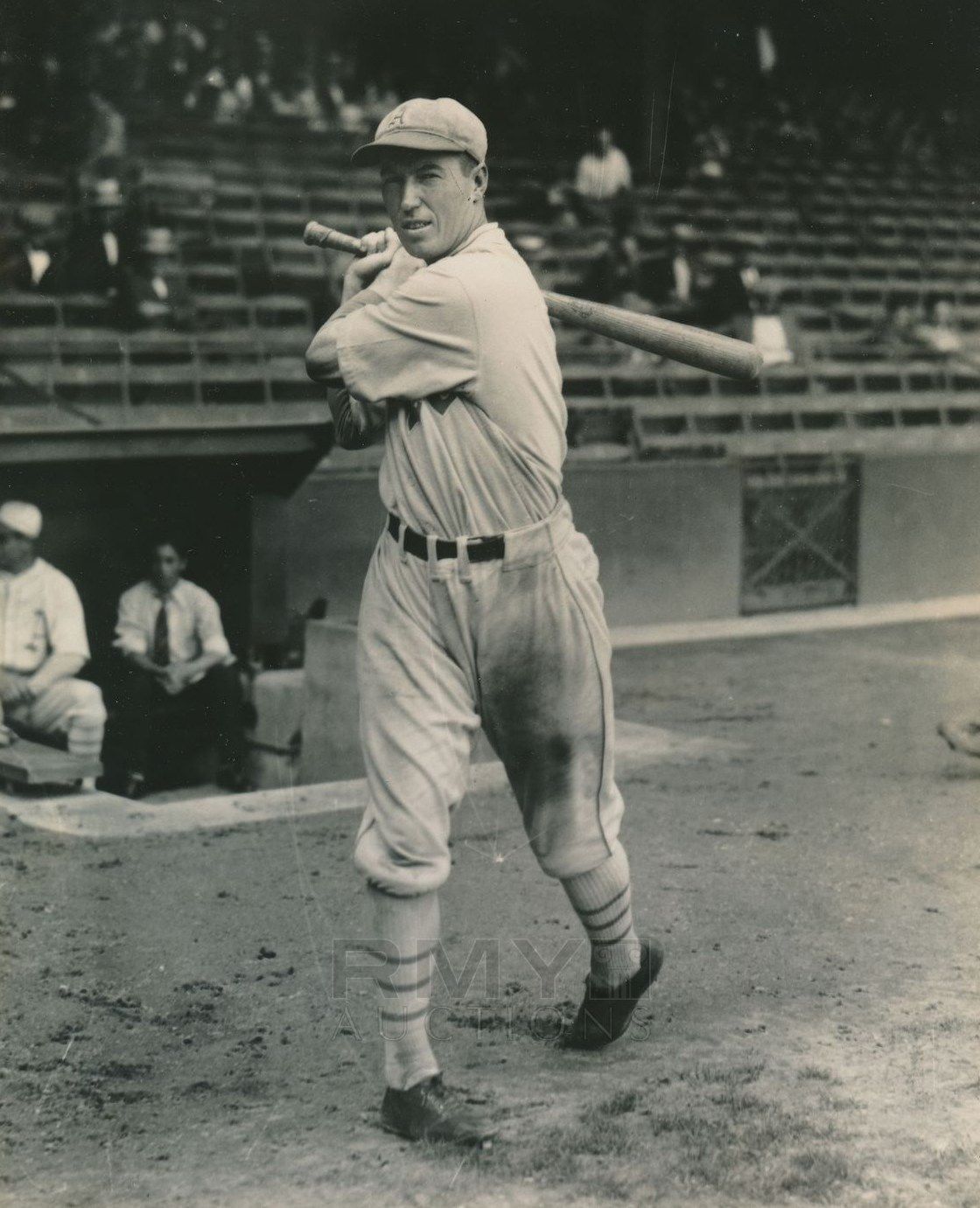
  24. Stuffy McInnis “It was the best of times, it was the worst of times…” During his 18-year career in the Major Leagues, John Phalen “Stuffy” McInnis’ teams finished in first place six times, winning five World Series, and in last place four times. He started his career by becoming the youngest member of Connie Mack’s famed “$100,000 infield,” replacing veteran Harry Davis at first base for the Philadelphia Athletics in 1911, and joining Eddie Collins, Frank (soon to be “Home Run”) Baker, and Jack Barry in that fabled infield. Following the dismantling of the Athletics after the 1914 season, Stuffy stayed on, suffering through three straight last-place A’s finishes. But whether it was feast or famine for his teams, McInnis remained a consistent singles hitter, an outstanding defensive first baseman, and a savvy clubhouse leader. A spry 5’ 9 ½” right-handed line-drive pull hitter with a boyish face, McInnis has a career batting average over .300, having amassed more than 2,400 hits. However, he is best known as one of baseball’s best defensive first basemen, due to his amazing consistency covering first base. The fourth of five sons of Stephen and Udavilla (Grady) McInnis, Stuffy was born September 19, 1890 in the fishing town of Gloucester, Massachusetts. His father provided a good living for the family variously as a caretaker of a stable of driving horses, a chauffeur, and a “call” fireman for the Colonel Allen Hook and Ladder, No. 1. All McInnis’ brothers played baseball, but Stuffy stood out from an early age. He gained his unique nickname during his boyhood playing days, when teammates and spectators would shout, “That’s the stuff, kid, that’s the stuff!” after he had made a good play. Playing shortstop, McInnis led Gloucester High School to championships in 1906 and 1907. In the summers of 1907 and 1908, he played for the Beverly, Massachusetts amateur baseball club. In July 1908, he joined the Haverhill Hustlers professional baseball club, and “soon became the sensation of the New England League,” according to the Philadelphia Athletics’ 1910 Championship Season Souvenir Program. He was paid $100 per month by the Hustlers, batting .301 in 186 at-bats under the tutelage of the legendary Billy Hamilton. On the advice of Dick Madden of the Beverly amateur club – who acted as a scout for the Athletics – McInnis was signed by A’s owner-manager Connie Mack at the end of 1908. Stuffy’s slight stature and boyish looks were the cause of some confusion in his earlier years. Once, before a New England League game, umpire Steve Mahoney asked Hamilton when he was going to get his mascot off the field, pointing at McInnis. “Mascot nothing!” snapped Hamilton, “That’s my shortstop and he’s one of the best you’ve ever seen.” In 1909, just 18 years old, McInnis was considered a potential rival for the starting shortstop position over Jack Barry, who had joined the major leagues just a year earlier. He stuck with the Athletics out of spring training, but ended up playing only 14 games – all at shortstop — in this first season. His major league debut on April 12 was an auspicious occasion for another reason, the grand opening of Shibe Park, the first steel and girder ballpark in the country. Jack Barry was injured, so Stuffy started in front of over 30,000 fans, a huge crowd for that era. Stuffy acquitted himself well, making an error but getting a hit as the Athletics defeated the Red Sox, 8-1, behind Eddie Plank. Stuffy finished the season with only a .239 batting average, but made himself useful off the bench, as he became particularly astute at stealing signs from opponents. In 1910, McInnis played at shortstop, second base, third base, and even in the outfield, batting .301 in 38 games. It was during this season that Connie Mack told Stuffy to start working out at first base, despite his short stature and lack of experience at the position. Ben Houser, who was trying to become the A’s regular first baseman, tried to run McInnis off first every time he tried to take groundballs or throws. But in 1911 Mack kept Stuffy and released Houser who had hit only .188. Before the 1911 season, Mack determined that McInnis would supplant regular first baseman Harry Davis, whose production had declined considerably in the previous year. However, when, early in the season, Jack Barry became sick, McInnis took over at shortstop instead. He played 24 games at shortstop, keeping Barry on the bench even some time after he recovered, due to his hot hitting. Eventually, Barry reclaimed shortstop, and McInnis took over first base from Davis. On September 23, 1911, Connie Mack included McInnis’ name on the list of the 21 players eligible to represent the A’s in the World Series. However, two days later, Stuffy sustained an injury to his right wrist when he was struck by pitch from the Tigers’ George Mullin. Though no bones were broken, McInnis’ right forearm became badly swollen, and he was unable to throw even from first base to the pitcher’s mound with any speed or accuracy. McInnis did not play the rest of the season. In 126 games in 1911, Stuffy hit for a .321 batting average. The Athletics won the 1911 American League pennant, limping into the World Series with the aged Davis replacing Stuffy at first base. It was the second year in a row that McInnis’ team played in the World Series without Stuffy taking a meaningful part in the outcome. However, with the Athletics up 13-2 with two outs in the ninth inning, and a 3-2 series lead, Mack put Stuffy into the game defensively at first base, so that Stuffy could say he’d played in a World Series. A’s pitcher Chief Bender promptly induced Giants catcher Artie Wilson to ground weakly to Frank Baker at third base. The Series ended as Stuffy touched the ball for the first time, nabbing Baker’s throw for the final putout. For Stuffy, it was the first of five World Series with three different teams. McInnis entered the 1912 season surrounded by great expectations and with huge shoes to fill. Harry Davis, despite his declining performance over the previous two seasons, had been one of the American League’s premier power hitters, and the A’s regular first baseman since Mack formed the team in 1901. McInnis responded to the expectations with an excellent season, batting in 101 runs, the fourth most in the league, and scoring another 83 in the effort, while batting for a .327 average. However, for the first time in three years, the Athletics failed to win the American League pennant. In 1913, the A’s got back on track, winning the American League pennant for the third time since McInnis joined the team. During the season, McInnis batted for a .324 average, with 90 runs batted in, which tied for second in the league. His defense also improved dramatically, providing a glimpse of his future defensive greatness. In the World Series, the Athletics beat the New York Giants in five games for the World Championship. McInnis slumped badly at the plate in the Series, garnering only two hits in 17 at-bats for a paltry .118 batting average. McInnis had another strong offensive year in 1914, finishing with a .314 batting average, including 95 runs batted in, second most in the league. The Athletics again won the American League pennant. They entered the 1914 World Series as heavy favorites over the Boston Braves. The Athletics managed only a lackluster offensive performance, scoring six runs in the improbable four-game sweep by the “Miracle Braves.” Stuffy again struggled at the plate in the Series, going 2-for-14 for a .143 average. The entire A’s team hit only a lackluster .172 for the four games. 1914 had begun with the defection of outfielder Danny Murphy, a team member since 1902, to the newly-formed rival Federal League. While the loss of Murphy, no longer a regular player, did not greatly weaken the Athletics in 1914, it was the harbinger for what was to be the end of the Philadelphia Athletics’ first dynasty. Philadelphia entered the 1915 season after losing starting pitchers Chief Bender and Eddie Plank to the Federal League, third baseman Baker to a rebellious one-year retirement, and second baseman Eddie Collins, in a sale by Mack, to the Chicago White Sox. The result was that they had no hope of winning even half their games, let alone competing for the pennant. To make matters worse, in July, Mack sold Barry’s contract to the Boston Red Sox, thus leaving McInnis as the sole remaining member of the Athletics’ once-feared infield. Although McInnis, too, was wooed by the Feds, he reportedly opted to stay with the Athletics out of loyalty to Connie Mack, even for considerably less money. Not surprisingly, however, McInnis’ next three years with the Athletics were unhappy ones as the A’s finished in the cellar in 1915, 1916, and 1917. Stuffy, however, continued to be productive, batting .314, .295, and .303 in those years to remain one of baseball’s premier first basemen. Stuffy had an interesting encounter with future teammate Babe Ruth early in the 1916 season. McInnis was walking across the lobby of the Bellevue-Stratford Hotel in Philadelphia on an April evening when he saw Babe Ruth relaxing in an easy chair. That afternoon Ruth had defeated the Athletics in Shibe Park and allowed only five hits, including one by McInnis. McInnis walked over to the Babe and said, “You pitched a fine game out there today, Babe. That fastball of yours was really hopping all afternoon.” McInnis later reported that although he had batted against Ruth many times in the past, the Babe looked him squarely in the eye and said, “Yeah, kid, it was a pretty good game. Glad you could get out to the ballpark and see it.” After the end of the 1917 season, Mack demanded that McInnis take a salary cut. When McInnis refused, Mack traded him to the Boston Red Sox in January 1918 for third baseman Larry Gardner, outfielder Tilly Walker, and backup catcher Hick Cady. After nine years with the Athletics, McInnis helped lead his new team to the war-shortened 1918 American League pennant. The Red Sox won the World Series four games to two primarily on the pitching of Babe Ruth and Carl Mays, but also with the timely hitting of McInnis and a few teammates. In the first game, McInnis singled home the only run of the game in the fourth inning as Babe Ruth shut out the Cubs, 1-0. In Game Three, Stuffy singled in the fourth and scored the deciding run on a squeeze bunt by Everett Scott in a 2-1 Red Sox victory. For the Series McInnis batted .250, well above the team’s lowly .186 average. He also fielded his position flawlessly. For example, in Game Four he took part in three double plays and made the pivotal defensive play of the game in the ninth inning, forcing Fred Merkle at third base on Chuck Wortman’s little tapper in front of the plate. Boston’s fortunes fell in 1919, 1920, and 1921, as first Mays and then Ruth were traded. The team finished in the bottom half of the American League each season, as McInnis again found himself on a team that had been dismantled for cash by its owner. McInnis hit for averages of .305, .297, and .307 in the three years, respectively. It was during this period that McInnis honed his first base defense to a point of near-infallibility. In 1919, he made seven errors in 118 games for a .995 fielding average. In 1920, he again made seven errors, this time in 148 games, for a league-leading .996 fielding average. In 1921, McInnis made only one error in 152 games for a record .9993 fielding average. Even that single error was debatable. It occurred on May 31st in Fenway Park against the Athletics. Jimmy Dykes was leading off first and the Red Sox catcher fired to McInnis on an attempted pick-off play. Stuffy dropped the ball on the tag and the official scorer charged him with an error. Even with that single bobble in late May, Stuffy’s 1,300 chances accepted without an error in 1921 set the record for errorless chances in a season. Further, from May 31, 1921 to June 2, 1922, McInnis went 163 games and 1,625 chances without making an error at first base. Stuffy did not drink or smoke and was “careful” in his speech. But he was proud of his fielding prowess. On June 23, 1919 McInnis was charged with his first error of that season after 526 chances when he could not handle a low throw from his old Athletics’ teammate, Jack Barry, who was playing as a part-time second baseman. Some 30 years later McInnis was coaching baseball at Harvard and Barry was the coach at Holy Cross. According to one of Stuffy’s former players, whenever Harvard played Holy Cross, the two old teammates would meet at home plate before the game to present their lineups and their greeting never varied: “How are you, Stuffy?” Barry would say. “Good. How are you, Jack?” Stuffy would reply, “You know that was a low throw, don’t you, Jack.” Before the 1922 season, McInnis was traded to the Cleveland Indians. He hit for a .305 batting average, making only five errors in 140 games. Cleveland finished fourth in the American League. After the season, McInnis was released on waivers. He signed with the Boston Braves, with whom he spent two seasons, batting .315 and .291 in 1923 and 1924, respectively. McInnis ultimately signed with the Pittsburgh Pirates for 1925. Playing in only 59 games, he hit for a .368 average, with a .437 on-base percentage and a .484 slugging average. Stuffy’s veteran leadership was instrumental in helping the young Pirates win the National League pennant. In the World Series against the Washington Senators, the Pirates lost three of the first four games. John McGraw, whose Giants had lost to the Senators the previous year, suggested to Pirates manager Bill McKechnie that he play McInnis at first base instead of the struggling George Grantham, to take advantage of Stuffy’s World Series experience. McKechnie took McGraw’s advice and the Pirates won three straight to come back for an improbable World Series win. McInnis’ steadying hand and timely hitting were major contributors to the Pirates comeback. McInnis played part-time for the Pirates again in 1926. He hit for a .299 average, but recorded only 127 at-bats in 47 games. The Pirates finished third in the National League. In 1927, McInnis returned to Philadelphia as manager of the Phillies. Despite some early-season heroics by the perpetually woeful “Flying Phils,” the team lost 103 games and ended up in its usual spot at the bottom of the National League. In 1928, Stuffy served as player-manager of the Salem Witches in the New England League. The 38-year old batted .339 in part-time duty. He went on to coach baseball at Norwich University, Cornell and Harvard. After six seasons of coaching Harvard, McInnis resigned in 1954 because of failing health. On February 16, 1960, after a lengthy illness, McInnis passed away in Ipswich, Massachusetts. He was 69 years old and had been preceded in death the previous year by his wife Elsie. Although known for his fielding wizardry, McInnis was an outstanding hitter as well. For his 18-year big league career, he batted .308 and hit over .300 14 times. He was known as a consummate contact hitter, striking out only 189 times in about 8,200 career at-bats. For three years of his career, he struck out fewer than 10 times in over 500 plate appearances. Only Joe Sewell has ever topped that feat. In 1922, Stuffy struck out only five times in 550 at-bats. In 1924, he whiffed only six times in almost 600 at-bats. On April 29, 1911, Stuffy went five-for-five, all singles, against the New York Highlanders’ Hippo Vaughn and Jack Quinn while seeing only seven pitches. He hit the first pitch he saw for a single three times and the second pitch twice. Typical of Deadball Era players, McInnis did not hit many home runs – only 21 for his career – and many were inside-the-park jobs, including two in one game on August 12, 1912 versus Vean Gregg of the Cleveland Naps. His most memorable home run, however, came on June 27, 1911 in a game at Huntington Avenue Grounds in Boston. McInnis stepped to the plate to lead off the seventh inning while the Red Sox were still warming up between innings. With Eddie Collins of the A’s still on the field talking to Red Sox center-fielder Tris Speaker, Stuffy hit a warm-up pitch by Ed Karger into short center field, which the Boston outfielders were not in a position to field. McInnis circled the bases for an inside-the-park home run against the unprepared Red Sox. The umpire upheld the homer and on appeal, American League president Ban Johnson refused to overturn the umpire’s ruling or the Athletics victory, based on a new, soon-to-be-withdrawn, rule prohibiting warm-up pitches between innings. Johnson had implemented the rule due to concern that some games were taking over two hours to play! While McInnis was an excellent hitter, it was as a fielder that he truly left a legacy. He was one of the earliest first basemen to excel at catching throws one-handed and he did so in a way that appeared natural and not flashy, as was often the case with his contemporary Hal Chase. His one-handed style enabled him to reach for high and wide throws, and helped him overcome the disadvantage of his rather short stature. He is also credited as the inventor of the “knee reach,” during which maneuver he performed a full, ground-level split in stretching for a throw. According to one report, he was also the first to wear the claw-type first baseman’s glove to improve his efficiency in scooping balls out of the dirt. With his fielding prowess, his lifetime batting average of .307 in 18 major league seasons, his participation in five World Series, and his membership in the best infield of the Deadball Era, Stuffy McInnis is certainly worthy of consideration for Baseball’s Hall of Fame. One thing is for certain: in his long career he lived up to his childhood nickname.
  25. 9 out of 10, 54 seconds. Today was harder than I imagined and of course I missed one that I should have known.
×
×
  • Create New...